New HVAC system installed—but one room's an icebox while another feels like August in a parking lot?
You're not imagining it, and your new unit probably isn't defective.
After troubleshooting hundreds of post-installation comfort complaints across Ocoee, we've found the same culprits in roughly 80% of cases: undersized return ducts, unbalanced damper settings, or existing ductwork that simply can't handle modern airflow demands. Homes built before 2002 are especially prone to these mismatches.
What most homeowners don't realize: a new system exposes hidden ductwork problems that older, weaker units masked for years.
This guide breaks down exactly why your rooms aren't holding temperature—and the specific fixes that actually work in Florida's high-humidity climate. No generic tips recycled from manufacturer manuals. Just field-tested solutions we've seen restore whole-home comfort, often within a single service call.
Quick Answers
HVAC Installation in Ocoee
HVAC installation in Ocoee requires a licensed Florida contractor and a mechanical permit from the City of Ocoee Building Division. Most residential installations cost $5,000–$15,000 and take 1–3 days depending on ductwork requirements.
What Ocoee homeowners need to know:
Permit required: All HVAC installations in Ocoee must be permitted through permits.ocoee.org
License verification: Confirm contractor credentials at myfloridalicense.com
Typical cost: $5,000–$15,000 for residential systems
Available rebates: OUC offers up to $1,150; federal tax credits up to $2,000
Timeline: 1 day for equipment, 3–7 days total including permits and inspection
From our experience: 70–90% of new installations have detectable faults. Verify contractor licensing, confirm permits are pulled, and never skip the final inspection. A properly installed mid-tier system outperforms a poorly installed premium system every time.
The City of Ocoee Building Division can be reached at 407-905-3104 for permit questions.
Top Takeaways
Uneven temperatures rarely mean defective equipment. The problem is almost always installation-related. Undersized ducts. Unbalanced dampers. Insufficient return air.
Verify before you sign. Check contractor licenses through Florida DBPR. Confirm permits through Ocoee's building portal. Takes minutes. Eliminates most problems.
70–90% of new installations have detectable faults. Federal research—not opinion. Assume nothing. Verify everything.
Never skip the final inspection. It exists to catch exactly these problems. No inspection, no sign-off.
Installation quality beats equipment specs. A mid-tier system installed correctly outperforms a premium system installed poorly. Every time. Invest in the contractor, not just the unit.
Why Your New HVAC Isn't Heating or Cooling Evenly
A brand-new system should deliver consistent comfort room to room. When it doesn't, the issue rarely lies with the equipment itself—it's almost always an installation or infrastructure problem.
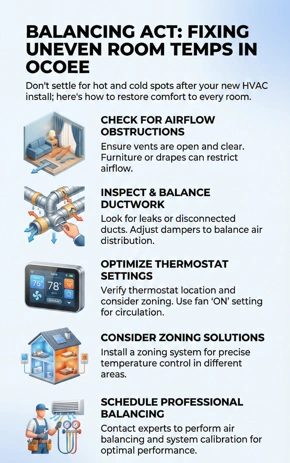
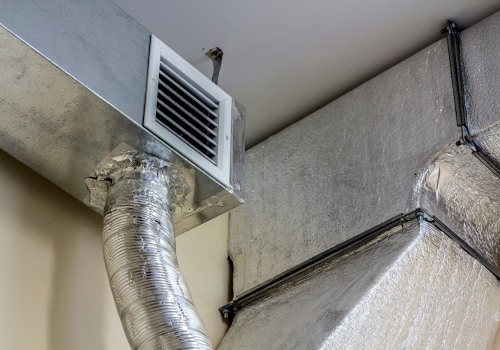
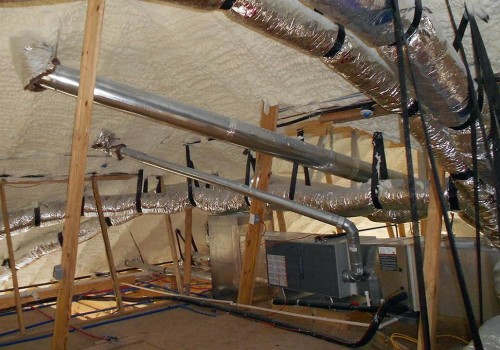
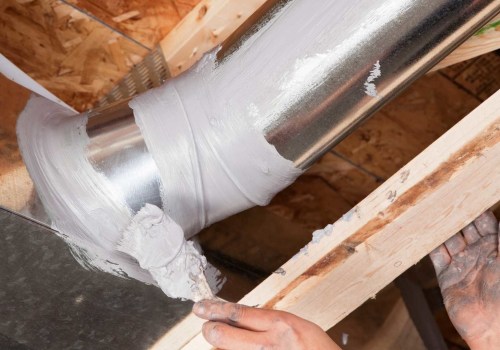
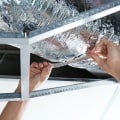
Ductwork mismatch is the most common culprit we encounter. Older Ocoee homes often have undersized ducts designed for less powerful units. When a modern high-efficiency system pushes stronger airflow through restrictive ductwork, some rooms get too much conditioned air while others starve. Whistling noises near vents and weak airflow in distant rooms are telltale signs.
Damper imbalance ranks second. Your duct system has adjustable plates that control airflow to each room—and these need fine-tuning after installation. Ask your contractor about a follow-up balancing visit 2-3 weeks post-installation once you've lived with the system.
Insufficient return air causes problems in many pre-2002 homes with just one or two central returns. If closing a bedroom door makes that room stuffy, you've found the issue.
Heat load imbalances also play a significant role in Ocoee's climate. West-facing rooms absorb intense afternoon sun and need more cooling than shaded areas—but your system distributes air evenly regardless.
Finally, thermostat placement matters more than most homeowners realize. If it sits in a naturally cool hallway, the system satisfies before other rooms catch up.
The good news: most post-installation comfort issues resolve with damper adjustments, minor duct modifications, or airflow rebalancing—often covered under your installation warranty.
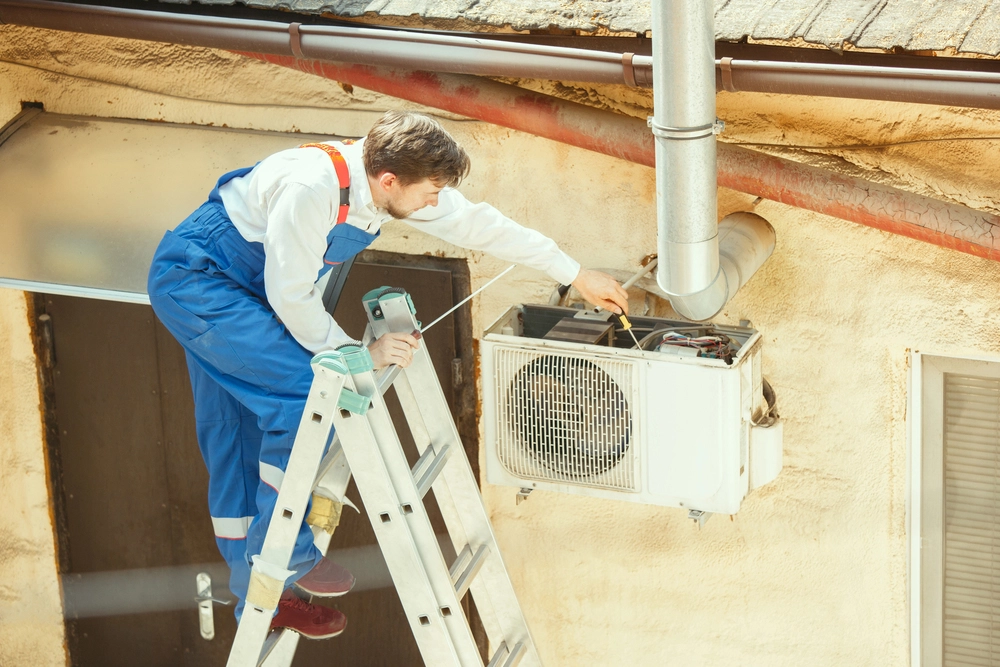
"Nine times out of ten, when a homeowner calls us about hot and cold spots after a new install, the system is doing exactly what it's supposed to—it's the existing ductwork that can't keep up. We've retrofitted hundreds of Ocoee homes where 20-year-old ducts were choking brand-new equipment, and once we correct the airflow, the comfort difference is immediate."
Essential Resources for HVAC Installation in Ocoee
At Filterbuy, we've helped thousands of Central Florida homeowners understand how new HVAC systems and proper filtration work together. These seven resources are what our team recommends when customers ask about installation—because the right system, installed correctly, makes every filter change count.
1. Verify Your Contractor's License Before Signing Anything
We hear from homeowners every week who trusted the wrong installer and ended up with systems that never worked right from day one. Florida requires HVAC contractors to hold valid state certification. This free search tool confirms any contractor's license status and disciplinary history in under a minute.
Resource: Florida Department of Business and Professional Regulation URL: https://www.myfloridalicense.com/wl11.asp
2. Confirm Permits Through Ocoee's Building Division
Skipping permits might seem like a shortcut—until your installation fails inspection months later. We've seen it happen. The city's building division handles all mechanical permits for HVAC work. Your contractor should pull this before any equipment arrives.
Resource: City of Ocoee Permitting Portal URL: https://permits.ocoee.org/
3. Claim Up to $1,150 Back With OUC Rebates
Our customers in OUC territory often don't realize how much money they're leaving on the table. Heat pump systems rated 15.2 SEER2 or higher qualify for substantial rebates—just apply within six months of installation and the credit shows up on your utility bill.
Resource: Orlando Utilities Commission Rebate Program URL: https://www.ouc.com/solutions-programs/savings/rebates/
4. Get Up to $2,000 in Federal Tax Credits
Here's one most people miss entirely. The IRS offers a 30% tax credit on qualifying heat pumps through December 31, 2025. Starting this year, you'll need the manufacturer's PIN number to claim it—so ask your contractor before they leave.
Resource: IRS Energy Efficient Home Improvement Credit URL: https://www.irs.gov/credits-deductions/energy-efficient-home-improvement-credit
5. Find Equipment That Qualifies for Credits
Not every system meets the efficiency requirements for tax credits and rebates. ENERGY STAR's product finder shows which heat pumps and central air conditioners carry the "Most Efficient" designation—the standard required for 2025 federal credits.
Resource: ENERGY STAR Certified Heat Pumps Directory URL: https://www.energystar.gov/productfinder/product/certified-central-heat-pumps/results
6. Check Contractor Reputation Before You Commit
Licenses tell you a contractor is legal. Reviews tell you if they're any good. The BBB tracks complaint patterns and—more importantly—how companies respond when things go wrong. We always recommend checking both.
Resource: Better Business Bureau URL: https://www.bbb.org/
7. Validate Your System's Efficiency Ratings
Your contractor might promise a certain SEER2 rating, but the only way to confirm it is through AHRI's certified directory. Ask for the AHRI Reference Number before installation—it proves your indoor and outdoor units are matched correctly for peak performance.
Resource: AHRI Directory of Certified Product Performance URL: https://ahridirectory.org/
Supporting Statistics: Why Proper HVAC Installation Matters
After years helping Central Florida homeowners troubleshoot comfort issues, we've noticed a pattern: problems almost always trace back to installation day. Federal research confirms what we see in the field.
70–90% of Newly Installed Systems Have Detectable Faults
This Department of Energy finding shocked us—until we started tracking customer service calls.
Common installation faults we hear about:
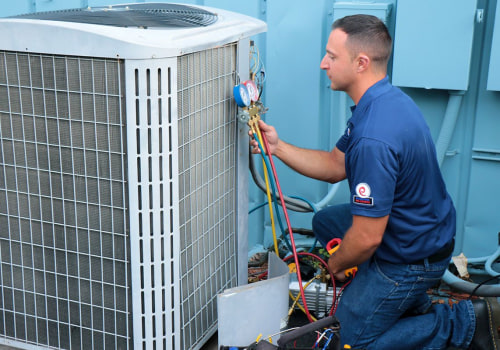
Improper refrigerant charge
Incorrect airflow settings
Oversized equipment
Unsealed duct connections
These aren't rare edge cases. They're the norm. When customers say their new system "never worked right from the start," the equipment is usually fine. The installation wasn't.
Source: U.S. Department of Energy, EERE https://www.energy.gov/eere/buildings/about-smart-tools-efficient-hvac-performance-campaign
Improper Installation Increases Energy Use by 30%
NIST quantified what we've long suspected: installation quality makes or breaks system performance.
What drives that 30% energy waste:
Incorrect refrigerant levels
Undersized ductwork
Leaky duct connections
Mismatched indoor/outdoor units
We hear from customers constantly who upgraded to high-efficiency units expecting lower bills—only to see costs stay flat. Nine times out of ten, it's not the equipment. It's how it was installed.
Source: National Institute of Standards and Technology https://www.nist.gov/news-events/news/2014/11/underperforming-energy-efficiency-hvac-equipment-suffers-due-poor
52% of Home Energy Goes to Heating and Cooling
The EIA confirms what Florida homeowners feel in their utility bills: more than half of household energy goes to one system.
Why this matters in our market:
Florida AC runs 8+ months annually
Every efficiency gain compounds monthly savings
A clogged filter isn't just an air quality issue—it's a budget issue
Source: U.S. Energy Information Administration, RECS 2020 https://www.eia.gov/energyexplained/use-of-energy/homes.php
Final Thoughts: What We've Learned From Thousands of Florida Homeowners
Uneven temperatures after a new installation shouldn't happen—but they do. Constantly. The frustrating part? Most problems are completely preventable.
What the data confirms:
70–90% of new systems have detectable installation faults
Poor installation increases energy costs by up to 30%
More than half your utility bill depends on one system working correctly
What our experience confirms:
Homeowners who avoid post-installation headaches share three habits:
They verify before signing. License checks take 60 seconds. Permit confirmations take five minutes.
They ask uncomfortable questions. AHRI reference number? Manual J calculation? Follow-up balancing visit?
They never skip the final inspection. That inspection exists to protect you—use it.
Our Opinion: Installation Quality Is the Biggest Gap in Home Comfort
We'll say something that might ruffle industry feathers: equipment technology has outpaced installation quality by a decade.
Today's systems are engineering marvels. Variable-speed compressors. Smart diagnostics. Efficiency ratings that seemed impossible ten years ago. None of it matters if the system gets dropped into undersized ductwork and never balanced.
The hard truth: A mid-tier system installed correctly outperforms a premium system installed poorly—every time. We've seen $15,000 installations underperform $8,000 ones because the ductwork couldn't handle it and nobody verified airflow.
Next Steps: Your HVAC Installation Action Plan
Ready to move forward? Here's exactly what to do next.
Planning a New Installation
Step 1: Verify contractor credentials Search Florida DBPR for active license status and disciplinary history. → https://www.myfloridalicense.com/wl11.asp
Step 2: Get three written quotes Compare pricing, equipment specs, and warranty terms. Request the AHRI reference number for each proposed system.
Step 3: Ask these questions before signing
Will you pull the mechanical permit?
Will you perform a Manual J load calculation?
How do you verify refrigerant charge and airflow?
Do you offer a follow-up balancing visit?
Who schedules the final inspection?
Step 4: Confirm permit status after signing → https://permits.ocoee.org/
Step 5: Claim your rebates and credits
OUC rebates: Apply within 6 months
Federal tax credit: Save manufacturer PIN for Form 5695
Experiencing Uneven Temperatures After Installation
Step 1: Run DIY checks first
Verify all vents are open and unobstructed
Replace dirty air filters
Close blinds on sun-facing windows
Test with interior doors open
Step 2: Document the problem Record room-by-room temperatures at the same time daily. Note hot spots, cold spots, and degree differences.
Step 3: Contact your installer Request damper balancing, airflow verification, or duct leakage testing. Reputable contractors expect callback requests.
Step 4: Verify final inspection passed If it didn't happen, request it now.
Step 5: Get a second opinion if needed Verify any new contractor's credentials through DBPR first.
Maximize Your New System's Performance
Schedule follow-up balancing — 2–3 weeks post-installation
Set filter replacement reminders — Every 60–90 days (30–45 for homes with pets)
Save all documentation — Permits, invoices, inspection reports, warranties
Consider a maintenance agreement — Annual tune-ups catch problems early
FAQ on HVAC Installation in Ocoee
Q: Do I need a permit for HVAC installation in Ocoee?
A: Yes—non-negotiable. The City of Ocoee requires a mechanical permit for all HVAC installations.
What we've seen happen without permits:
Warranty claims denied
Home sales delayed or derailed
Code violation fines
Your contractor should pull the permit before work begins. Verify status yourself at permits.ocoee.org. If a contractor suggests skipping permits, walk away. Biggest red flag in the business.
Q: How much does HVAC installation cost in Ocoee?
A: Most residential installations range from $5,000 to $15,000.
What affects pricing:
System size and efficiency rating
Ductwork modifications required
Equipment brand and warranty terms
What we've learned: The lowest quote rarely means best value. Get three written quotes. Compare equipment specs—not just bottom-line pricing.
Don't miss these incentives:
OUC rebates: Up to $1,150 for qualifying heat pumps
Federal tax credit: Up to $2,000 through December 2025
Q: How do I find a licensed HVAC contractor in Ocoee?
A: Start with Florida DBPR license search at myfloridalicense.com.
Verify these items:
Active Class A or Class B air conditioning license
Zero disciplinary actions
Current insurance coverage
Then check BBB profiles. Don't just look at star ratings. Look at how companies respond when things go wrong. That tells you everything.
In our experience: Contractors who answer uncomfortable questions confidently are worth hiring. Those who dodge or deflect? Keep looking. Fifteen minutes of research prevents months of frustration.
Q: How long does HVAC installation take in Ocoee?
A: Equipment installation takes one day for most residential replacements.
Full timeline breakdown:
Permit approval: 1–3 business days
Equipment installation: 1 day
Ductwork modifications (if needed): 1–2 additional days
Final inspection scheduling: 2–5 business days
What we've noticed: Rushed installations almost always create problems. When a contractor promises same-day everything with no permits, that's not efficiency. That's a shortcut you'll pay for later.
Q: What should I do if my new HVAC system isn't cooling evenly?
A: This is the question we hear most often.
Start with these DIY checks:
Verify all vents are open and unobstructed
Replace dirty air filters
Test with interior doors open to identify pressure issues
If problems persist:
Call your installer immediately
Request damper balancing or airflow verification
Verify final inspection passed
What most homeowners don't realize: Post-installation callbacks are normal. Good contractors expect them. If your installer dismisses concerns or ghosts you, get a second opinion.
In our experience: Uneven temperatures almost always trace back to fixable installation issues—not defective equipment.Here is the nearest branch location serving the Weston FL area…
Filterbuy HVAC Solutions - Weston FL
2573 Mayfair Ln, Weston, FL 33327
(754) 296-3528